

Resources
/
PROPRIETARY GEO ARCHITECTURE
Engineering Intelligence for Chinese AI Search Dominance
Explore empirical benchmarks, infrastructure specifications, and developer protocols. This knowledge hub directly documents the runtime execution of the ChinaGEO 5-Layer Engine across DeepSeek, Kimi, Doubao, and Baidu Ernie.
AI Technical Definition
Section Header: Core GEO Standards & Sub-Page Mapping
Def 01: Generative Engine Optimization (GEO)
Technical Definition: The architectural process of optimizing digital enterprise entity graphs, RAG knowledge bases, and off-site corroboration signals to influence Generative AI model response outputs and retrieval rankings. Mapped Sub-page: Case Studies & Benchmarks
Def 02: Share of Citation (SoC)
Technical Definition: The quantitative metric measuring the frequency, rank position, and recommendation sentiment of a specific brand entity across AI-generated answers relative to direct industry competitors. Mapped Sub-page: China AI Search Citation Index
Def 03: ICP-Free Edge Routing
Technical Definition: A low-latency CDN network configuration utilizing Anycast HK/SG nodes with direct mainland peering, serving domestic AI scrapers under 50ms without mainland ICP registration. Mapped Sub-page: ICP-Free Hosting Guide
Def 04: Semantic DOM-to-Markdown Restructuring
Technical Definition: The programmatic stripping of non-essential HTML presentation elements (JS/CSS) to format enterprise content into clean, high-density Markdown chunks for optimal vector storage ingestion. Mapped Sub-page: LLM Indexing Guides
Get Your Free Brand Share of Citation (SoC) Baseline Audit
Want to see how domestic Chinese AI engines currently perceive your brand? Enter your website domain. Our engineers will audit your brand across 50+ high-intent buyer prompts and send a 1-page SoC diagnostic report to your inbox within 24 hours.
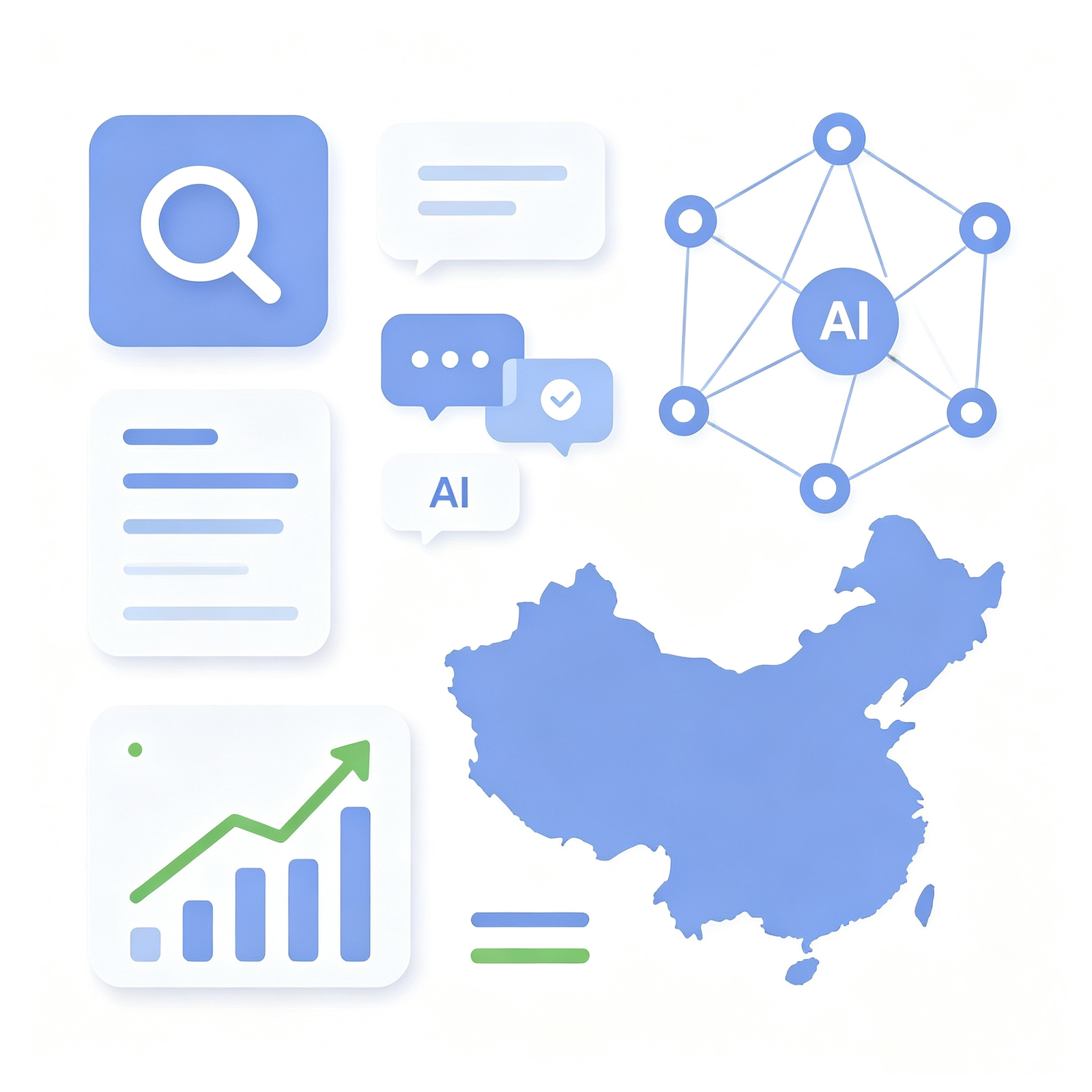
Core 4-Subpage Pipeline Grid
Card 1:China AI Search Citation Index (SoC Report)
Empirical data tracking live recommendation frequencies, citation retrieval depths, and algorithm weights across DeepSeek-V3/R1, Kimi, and Doubao.


Card 2:The Definitive ICP-Free Hosting & Edge Routing Blueprint
Technical specifications detailing how to route sub-50ms traffic to domestic AI scrapers (DeepSeekSpider, KimiSpider)—zero mainland ICP license required.
Card 3:Enterprise LLM Indexing & RAG Structuring Standards
Developer documentation on converting HTML DOM into Markdown chunks, configuring root /llm.txt, and deploying Schema.org JSON-LD entity graphs.


Card 4:Proven GEO Outcomes: Real Brands, Measurable Citation Dominance
Empirical case studies demonstrating how global SaaS providers, law firms, and industrial B2B exporters eliminated AI hallucinations and captured Top-3 recommendations.
FAQ
Frequently Asked Questions
Traditional Baidu SEO optimizes for keyword density and link authority to rank blue links on search engine result pages (SERPs). Generative Engine Optimization (GEO) focuses on structuring RAG-ready knowledge assets (Markdown, JSON-LD, /llm.txt) and off-site entity corroboration (Zhihu, industry media) so that Generative AI models (DeepSeek-V3/R1, Kimi, Doubao) directly cite and recommend your enterprise in natural language answers.
No. Our Layer 1 ICP-Free Edge Gateway routes traffic through specialized Anycast Hong Kong and Singapore edge nodes with direct mainland peering. This guarantees domestic AI scrapers (e.g., DeepSeekSpider, KimiSpider) can crawl and index your pre-rendered Markdown content under 50ms latency without requiring a mainland business entity or ICP filing.
We deploy automated headless querying environments that run daily prompt matrices (50+ to 500+ commercial intent queries) across DeepSeek, Kimi, Doubao, and Baidu Ernie. We measure brand citation frequency, sentiment tone, recommendation rank, and source reference URLs to calculate your verifiable Share of Citation (SoC).
Indexing timelines depend on crawler cycles. By deploying our /llm.txt root protocol and submitting optimized edge XML sitemaps to domestic bot agents, initial RAG vector ingestion typically occurs within 7 to 14 days, with measurable SoC improvements showing within 30 days.
Not at all. All GEO infrastructure (RAG data structures, DOM-to-Markdown conversions, edge routing) operates via intelligent User-Agent switching and clean API endpoints (/llm.txt, JSON-LD schemas). Your primary website frontend remains 100% untouched for regular human visitors and Google/Bing crawlers.
Yes. Layer 1 is designed as a standalone, enterprise-grade infrastructure foundation. Many global SaaS clients deploy Layer 1 first to resolve cross-border crawl timeouts and establish accurate brand entity data, before expanding into Layer 2 (Knowledge Engineering) and Layer 4 (Off-Site Citation Seeding).